
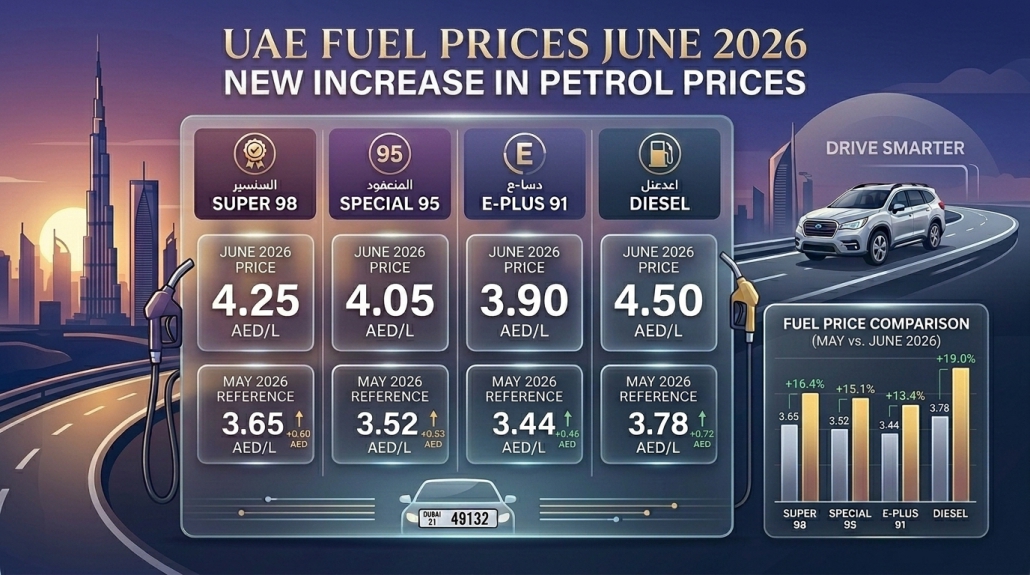
UAE Fuel Prices June 2026 – Latest Petrol & Diesel Rates
UAE Fuel Prices June 2026 Overview
The latest UAE Fuel Prices 2026 update brought another increase in petrol prices across all grades, while diesel prices recorded a noticeable decrease compared to May 2026. The new rates became effective on June 1, 2026, following the monthly review conducted by the UAE Fuel Price Committee.
Fuel prices remain an important topic for residents, businesses, and vehicle owners because transportation expenses are directly linked to monthly fuel costs. As fuel prices continue to fluctuate, many drivers are paying closer attention to fuel-efficient vehicles and operating expenses.
UAE Fuel Prices June 2026
The official fuel rates for June 2026 are as follows:
| Fuel Type | Price Per Litre |
|---|---|
| Super 98 Petrol | AED 3.95 |
| Special 95 Petrol | AED 3.83 |
| E-Plus 91 Petrol | AED 3.76 |
| Diesel | AED 4.33 |
These rates apply across all emirates and fuel stations throughout the UAE.
UAE Fuel Prices June 2026 Compared to May
Petrol prices increased during June 2026, while diesel prices declined.
| Fuel Type | May 2026 | June 2026 | Difference |
|---|---|---|---|
| Super 98 | AED 3.66 | AED 3.95 | + AED 0.29 |
| Special 95 | AED 3.55 | AED 3.83 | + AED 0.28 |
| E-Plus 91 | AED 3.48 | AED 3.76 | + AED 0.28 |
| Diesel | AED 4.69 | AED 4.33 | – AED 0.36 |
The increase reflects ongoing movements in global energy markets and crude oil prices.
Why UAE Fuel Prices June 2026 Increased
Several factors contributed to the latest UAE Fuel Prices 2026 increase.
Global Oil Market Trends
Crude oil prices remain one of the primary drivers of fuel pricing. Changes in global supply and demand can quickly impact fuel rates in the UAE.
Increased Transportation Demand
Demand for petrol continued to grow across transportation and commercial sectors, contributing to higher prices.
Monthly Pricing Mechanism
The UAE follows a market-based pricing system that adjusts fuel prices according to international energy market conditions.
How UAE Fuel Prices June 2026 Affect Drivers
The latest UAE Fuel Prices 2026 update is expected to impact daily commuters and businesses alike.
Some of the most common effects include:
- Higher monthly fuel expenses
- Increased commuting costs
- Higher transportation costs for businesses
- Greater interest in economical vehicles
- Increased demand for hybrid and electric vehicles
Many UAE residents are now considering fuel efficiency as a key factor when purchasing a vehicle.
Best Cars to Handle UAE Fuel Prices June 2026
As fuel prices continue to rise, economical vehicles are becoming more attractive.
Popular fuel-efficient models include:
- Toyota Yaris
- Nissan Sunny
- Hyundai Accent
- Kia Pegas
These vehicles offer lower fuel consumption and affordable maintenance costs.
Drivers looking to reduce ownership expenses may also find value in our guide to Cheap Cars in UAE 2026. Buyers with larger households can explore Best Family Cars UAE 2026 to compare family-friendly options. Additionally, understanding Car Maintenance Costs UAE can help drivers manage long-term vehicle expenses.
Tips to Reduce Fuel Costs
Drivers can minimize the impact of rising fuel prices by following several practical strategies:
- Maintain proper tyre pressure
- Avoid aggressive acceleration
- Perform regular vehicle maintenance
- Reduce unnecessary vehicle weight
- Plan routes efficiently
- Consider hybrid or fuel-efficient vehicles
These simple habits can significantly improve fuel economy and reduce transportation costs.
Conclusion
The latest UAE Fuel Prices 2026 update introduced higher petrol prices across all grades, with Super 98 reaching AED 3.95 per litre, Special 95 increasing to AED 3.83 per litre, and E-Plus 91 rising to AED 3.76 per litre. Meanwhile, diesel prices fell to AED 4.33 per litre.
As fuel costs continue to reflect global energy market conditions, many UAE residents are increasingly exploring fuel-efficient, hybrid, and electric vehicles to reduce long-term transportation expenses. Staying informed about monthly fuel price updates remains essential for managing personal and business transportation budgets effectively.
